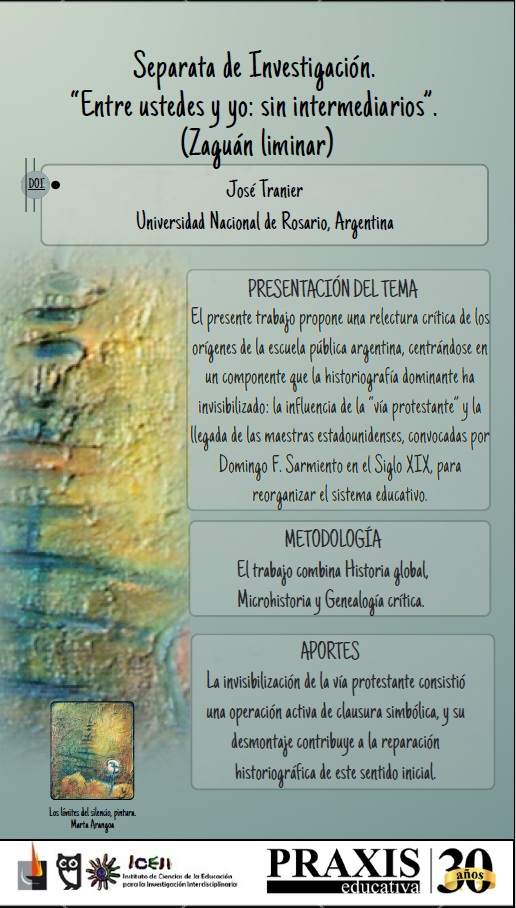
Suplemento de investigação. “Entre nós dois: sem intermediários” (Vestíbulo interior)
DOI:
https://doi.org/10.19137/praxiseducativa-2026-300102Palavras-chave:
Sala de aula global/Capital global, disputas historiográficas e silêncios na construção do Estado,, genealogias do sistema educacional, pedagogia secular, feminina, estatal e republicana.Resumo
Este artigo propõe uma reinterpretação crítica das origens do sistema de ensino público argentino, com foco em
um componente que a historiografia dominante tornou invisível: a influência do “caminho protestante” e a
chegada de professores americanos, convocados por Domingo F. Sarmiento no século XIX, para reorganizar o
sistema educacional. A hipótese central é que o sistema de ensino público não nasceu como um instrumento de
disciplina estatal, mas sim como uma experiência de cooperação, soberania popular, democracia, laicidade,
republicanismo e prefiguração feminista. Herdeiros da Reforma Protestante, do pensamento de Comenius e da
Revolução Inglesa, ele transcendeu os marcos liberais, católicos e culturais de um Estado nascente que, tanto
imediata quanto posteriormente, buscou discipliná-lo. Metodologicamente, o artigo combina história global,
micro-história e genealogia crítica, concluindo que a invisibilidade do caminho protestante constituiu uma
operação ativa de fechamento simbólico, e seu desmantelamento contribui para a reparação historiográfica desse
significado inicial
Downloads
Referências
Barrancos, D. (2022). Mujeres movilizadas en América Latina. CLACSO
Bernard, C. (2018). El reto de las historias conectadas. Historia Crítica, (70), 3–22.
https://www.scielo.org.co/pdf/rhc/n70/0121-1617-rhc-70-00003.pdf
Bertrand, R. (2015). Historia global, historias conectadas: ¿Un giro historiográfico? Prohistoria,
(24).http://ref.scielo.org/g75rf7
Carzoglio, M. I. (2020). De lo local a lo global en el espacio de las historias conectadas. Cuadernos de H Ideas,
(14), 1–11.
https://perio.unlp.edu.ar/ojs/index.php/cps/article/view/6570/5537
Comenio, J.A. (1978). Didáctica Magna. Porrúa.
Chakrabarty, D. (2018). The crises of civilization: Exploring global and planetary histories. Oxford University
Press.
Gálvez, M. (2021) La maestra normal. UNIPE Editorial Universitaria
Gruzinski, S. (1994). La guerra de las imágenes: De Cristóbal Colón a “Blade Runner” (1492–2019). Fondo de
Cultura Económica.
James; D. (2025) Doña María. Historia de vida, memoria e identidad política. Editorial Mandolina
Levi, G. (2018). Microhistoria e historia global. Historia Crítica, (69), 21–35.
Sarlo, B (2017) La máquina cultural: Maestras, traductores y vanguardistas, Siglo XXI editores
Publicado
Edição
Seção
Licença
Copyright (c) 2026 Jose Tranier

Este trabalho está licenciado sob uma licença Creative Commons Attribution-NonCommercial-ShareAlike 4.0 International License.
Aviso de direitos autorais
Comitê Editorial Revista Práxis Educativa:
Declaro que sou o autor do artigo intitulado (nome do artigo), que o mesmo é original e de minha autoria e que não foi publicado anteriormente em qualquer outro formato ou meio. Declaro saber que a revista não me cobrará nenhum tipo de taxa em hipótese alguma, nem receberei qualquer tipo de remuneração monetária.
Caso seja aceito para publicação na Práxis Educacional, autorizo a referida revista a publicá-lo digitalmente e a divulgá-lo em suas redes sociais.
Se o trabalho for publicado, aderi à licença Creative Commons denominada "Atribuição - Compartilhamento Não Comercial pela mesma Licença CC BY-NC-SA", por meio da qual é permitido copiar, reproduzir, distribuir, comunicar publicamente o trabalho e gerar trabalhos derivados , desde que o autor original seja citado e reconhecido. Esta licença está em uso desde setembro de 2018. Em 2016 foi aderido ao CC BY NC ND 4.0; e nos anos de 2017 e 2018 (janeiro-agosto) CC BY NC 4.0.
Esta licença CC BY-NC-SA Share Alike não permite, entretanto, o uso comercial da obra. Como autor, a revista poderá estabelecer acordos adicionais para a distribuição não exclusiva da versão do trabalho publicado na revista, permite-me autoarquivar os artigos publicados, na sua versão post-print, em repositórios institucionais, temáticos , páginas web pessoais ou qualquer outro uso relevante. com o reconhecimento de ter sido publicado pela primeira vez nesta revista.
SA Práxis Educacional adere à DORA (Declaração sobre Avaliação de Pesquisa) assinada em São Francisco, Califórnia, em 16 de dezembro de 2012, e à Declaração do México (Declaração Conjunta LATINDEX - REDALYC - CLACSO - IBICT).









_(1)2.png)


3.png)








_(2).png)






2.jpg)