Hegemony of scientific knowledge: epistemic injustice and the natural sciences curriculum in Chile
DOI:
https://doi.org/10.19137/praxiseducativa-2026-300109Keywords:
hegemony of scientific knowledge, scientism, social and cultural diversity, epistemic injusticeAbstract
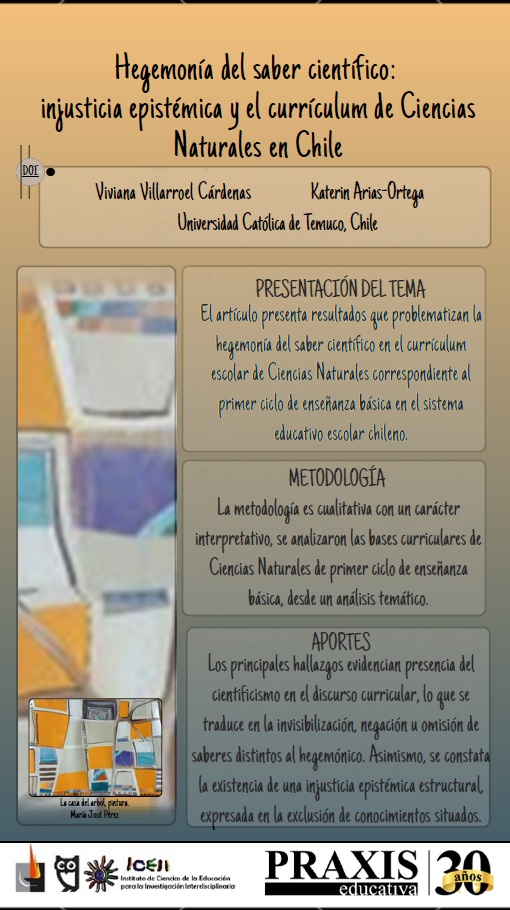
This article presents research results that problematize the hegemony of scientific knowledge in the Natural Sciences curriculum for the first cycle of basic education in the Chilean school system. The methodology is qualitative and interpretive; the curricular foundations of the natural sciences subject in the first cycle of basic education were analyzed. The information was approached through thematic analysis. The main findings demonstrate the presence of scientism in the curricular discourse, which translates into the invisibility, denial, or omission of knowledge other than the hegemonic one. Furthermore, the existence of a structural epistemic injustice is confirmed, expressed in the exclusion of situated knowledge. Based on this, we argue that this exclusion contributes to reproducing a monocultural curricular logic, removed from the sociocultural reality of students who pursue their schooling in educational settings with social and cultural diversity. We conclude that it is necessary to move toward a critical review of the science curriculum that recognizes and integrates other knowledge systems, fostering relevant, inclusive, and culturally relevant educational processes.
Downloads
References
Albertini, R., Babul, J., Cárdenas-Jirón, G., Díaz Véliz, G., Eyzaguirre, J., Labra, A., & Lewin, R. (2005).
Enseñanza de las ciencias a nivel escolar y formación en ciencia en el pregrado universitario. En T. Ureta, J. Babul, S. Martínez & J. Allende (Eds.), Análisis y Proyecciones de la Ciencia Chilena 2005.
Academia de Ciencias. https://www.academia-ciencias.cl/?module=investig.
Arias-Ortega, K., Quintriqueo, S., & Valdebenito, V. (2018). Monoculturalidad en las prácticas pedagógicas en la
formación inicial docente en La Araucanía, Chile 1. Educacão e pesquisa, 44, 1-18. https://doi.org/10.1590/S1678-4634201711164545
Arias-Ortega, K. & Villarroel, V. (2024). (In) justicia social en la educación rural en contextos indígenas en
Chile. Magis: Revista Internacional de Investigación en Educación, (17), 1-21.
Benarroch, A. (2001). Interculturalidad y enseñanza de las ciencias. Revista Alambique, 29, 9-23. Recuperado de
https://www.academia.edu/3368337/Interculturalidad_y_ense%C3%B1anza_de_las_ciencias
Bodner, G. M., & Herron, J. D. (2002). Problem-solving in chemistry. En M. N. Coutanche, S. Martínez, & M.
K. D. Rindskopf (Eds.), Chemical education: Towards research-based practice (pp. 235-266). Springer Netherlands.
Braun, V., & Clarke, V. (2023). Análisis temático. En H. Cooper, M. N. Coutanche, L. M. McMullen, A. T.
Panter, D. Rindskopf, & K. J. Sher (Eds.), Manual APA de métodos de investigación en psicología:
Diseños de investigación: Cuantitativos, cualitativos, neuropsicológicos y biológicos (2.a ed., pp. 65-81). Asociación Americana de Psicología. https://doi.org/10.1037/0000319-004
Braun, V., & Clarke, V. (2006). Using thematic analysis in psychology. Qualitative research in psychology, 3(2), 77-101.
Bunge, M. A. (2017). El planteamiento científico. Revista cubana de salud pública, 43(3), 1-29.
Carter, L. (2003). Thinking differently about cultural diversity: Using postcolonial theory to (re)read science
education. Science of Education, 88, 819-836. https://doi.org/10.1002/sce.20000
Castillo-Retamal, F., & Cordero-Tapia, F. (2019). La educación ambiental en la formación de profesores en Chile. UCMaule, (56), 9-28.
Castro Sánchez, F. D. J., Vega Falcón, V., Verano Gómez, N. C., & Camaño Carballo, L. (2022). Dimensión cultural en el currículo. Análisis de una experiencia. Conrado, 18(85), 151-159.
Cohen-Emerique, M. (2013). Per un enfocament intercultural en la intervenció social. Educació social. Revista d'intervenció socioeducativa, (54), 11-38.
Dalmau Corredor, V., & Arévalo Lozano, L. V. (2021). Corazonar y escuchar para construir memoria desde la interculturalidad y el territorio: Voces de maestras en escuelas rurales.
Dietz, G. (2018). Interculturality. The international encyclopedia of anthropology, 1-19.
Fernández, I., Gil, D., Alís, J. C., Cachapuz, A. F., & Praia, J. (2002). Visiones deformadas de la ciencia transmitidas por la enseñanza. Enseñanza de las ciencias: revista de investigación y experiencias didácticas, 477-488.
Galli, L. G., & Meinardi, E. (2015). Obstáculos para el aprendizaje del modelo de evolución por selección natural, en estudiantes de escuela secundaria de Argentina. Ciência & Educação, 21(1), 101-122.
Gasparatou, R. (2017). Scientism and scientific thinking: A note on science education. Science & Education, 26(7), 799-812.
Gonzalez Galli, L. M. (2020). Enseñanza de la biología y pensamiento crítico: la importancia de la metacognición.
Guevara, A., & Lemus-Barrios, M. (2019). Las jornadas científicas fortalecen la enseñanza-aprendizaje de aspectos biológicos en educación primaria y secundaria. RECIE. Revista Caribeña de Investigación Educativa, 3(1), 95-101.
Lander, E. (2000). Ciencias sociales: saberes coloniales y eurocéntricos. La colonialidad del saber: eurocentrismo y ciencias sociales. Buenos Aires, Argentina: Perspectivas latinoamericanas.
Legendre, R. (2001). Une Education á Eduquer. Montreal: GUÉRIN.
López, M., Moreno, E., Uyaguari Flores, J. F., & Barrera Mendoza, M. P. (2022). El desarrollo del pensamiento crítico en el aula: testimonios de docentes ecuatorianos de excelencia. Areté, Revista Digital del Doctorado en Educación, 8(15), 161-180.
Maders, S., & Barcelos, V. (2020). Educacao escolar indígena e intercultura: Um diálogo possivel e necessário. Education Policy Analysis Archives, 28, 167-167.
Ministerio de Educación (2018). Bases curriculares. 7o básico a 2o medio. Santiago, Chile. Recuperado de https://media.mineduc.cl/wp-content/uploads/sites/28/2017/07/Bases-Curriculares-7o-básico-a-2o-medio .pdf
Morales, J. (2021). La experimentación en ciencias naturales como estrategia de alfabetización científica. UCMaule, (60), 102-116.
Polo Blanco, J., & Piñeiro Aguiar, E. (2019). Ciencia moderna, planeta torturado Una reflexión crítica sobre el modo eurocéntrico de conocer la naturaleza e intervenir en el medio ambiente. Izquierdas, (46), 194-217.
Pozo Municio, J. I. (2016). Aprender en tiempos revueltos. La nueva ciencia del aprendizaje.
Quijano, A. (2000). Colonialidad del poder, eurocentrismo y América latina. En Lander, E. (Ed), La colonialidad del saber: eurocentrismo y ciencias sociales. Perspectivas latinoamericanas, 201-246. Buenos Aires, FLACSO. Recuperado de http://biblioteca.clacso.edu.ar/clacso/se/20140507042402/eje3-8.pdf
Saavedra, E., & Quilaqueo, D. (2021). Desafío epistemológico de los conocimientos educativos indígena y escolar para una educación intercultural. Educação e Pesquisa, 47, e231832.
Sánchez Arteaga, J., Sepúlveda, C., & El-Hani, C. (2013). Racismo científico, procesos de alterización y enseñanza de ciências.
Sartorello, S. (2021). Milpas Educativas: Entramados socionaturales comunitarios para el buen vivir. Revista mexicana de investigación educativa, 26(88), 283-309.
Sasseron, L., & Carvalho, A. (2011). Alfabetização científica: uma revisão bibliográfica. Investigações em Ensino de Ciências, 16(1), 59-77.
Vidal-Moscoso, D., & Manriquez-López, L. (2016). El docente como mediador de la comprensión lectora en universitarios. Revista de la educación superior, 45(177), 95-118.
Villarroel, V., Arias-Ortega, K., Lagos, R., & Quintriqueo, S. (2024). Enseñanza de las ciencias naturales: mecanismo de dominación en contexto indígena. Foro de Educación, 22(2),325-342. https://doi.org/10.14201/fde.22217
Villarroel, V., & Arias-Ortega, K. (2025). Repensar la formación inicial docente en ciencias naturales: una perspectiva intercultural chilena en La Araucanía. Acta Scientiarum. Education, 47, 1-11. https://doi.org/10.4025/actascieduc.v47i1.70651
Villarroel, V., Arias-Ortega, K., Lagos, R., & Quintriqueo, S. (2025). Métodos educativos indígenas para una didáctica de las ciencias naturales en perspectiva intercultural. Acta Scientiae, 27(2), 1-23. https://doi.org/10.17648/acta.scientiae.8317
Published
Issue
Section
License
Copyright (c) 2026 Viviana Villarroel Cárdenas, Dra. Katerin Arias-Ortega

This work is licensed under a Creative Commons Attribution-NonCommercial-ShareAlike 4.0 International License.
Copyright Notice
Editorial Committee Educational Praxis Magazine:
I hereby declare that I am the author of the article titled (article name), that it is original and my own and that it was not previously published in any other format or medium. I declare to know that the magazine will not charge me any type of fee under any circumstances, nor will I receive any type of monetary compensation If it were accepted for publication in Educational Praxis, I authorize the aforementioned magazine to publish it digitally and to advertise it on its social networks.
If the work is published, I adhere to the Creative Commons license called "Attribution - Non-Commercial Share Alike CC BY-NC-SA", through which it is allowed to copy, reproduce, distribute, publicly communicate the work and generate derivative works, as long as when the original author is cited and acknowledged. This license has been used since September 2018. In 2016 CC BY NC ND 4.0 was adhered to; and in the years 2017 and 2018 (January-August) CC BY NC 4.0.
This CC BY-NC-SA Share Alike license does not, however, permit commercial use of the work. As an author, the journal may establish additional agreements for the non-exclusive distribution of the version of the work published in the journal, it allows me to self-archive the published articles, in their post-print version, in institutional, thematic repositories, personal web pages or any other relevant use. with the recognition of having been first published in this journal.
Educational Praxis adheres to DORA (Declaration on Research Assessment) signed in San Francisco, California, on December 16, 2012, and to the Declaration of Mexico (Joint Declaration LATINDEX - REDALYC - CLACSO - IBICT).









_(1)2.png)


3.png)








_(2).png)






2.jpg)