Lights and shadows of Gestalt theory.
Gestalt Principles in Audiovisual Narratives
DOI:
https://doi.org/10.19137/praxiseducativa-2026-300118Keywords:
Gestalt Theory, Audiovisual Arts, Film, artistic education, Art DirectionAbstract
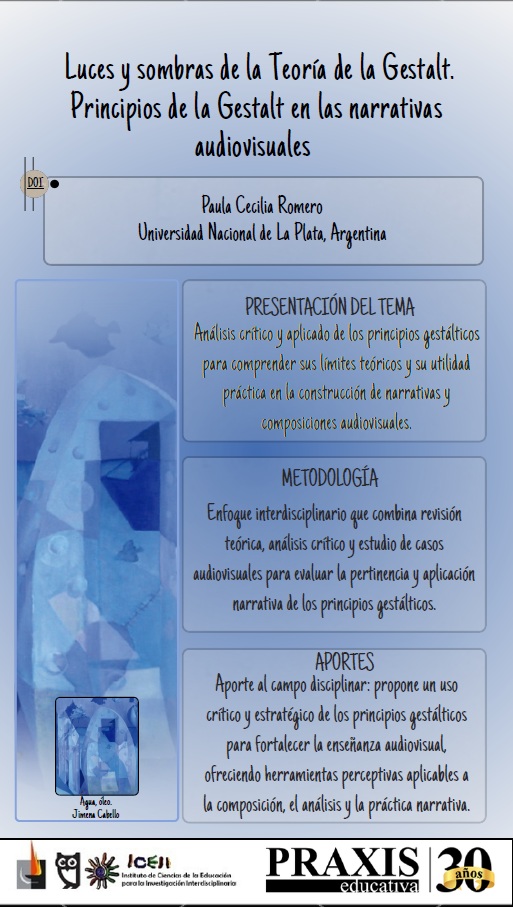
Gestalt theory emerged in the cultural and intellectual context of interwar Germany, as a reaction to the reductionism of structuralism in psychology. It proposed that perception is an active and global process, where wholes are perceived before parts. Although initially highly influential, its "laws" were later questioned for their supposed universality, lack of neuroscientific basis, and neglect of the cultural, historical, and subjective context of the observer. However, its practical usefulness in audiovisual arts is still valued today. Understood not as dogma, but as a set of general principles of perceptual organization, Gestalt can enrich visual narrative, guiding attention and generating balance or tension as required by the work. Therefore, its critical incorporation into audiovisual training is proposed, especially in areas such as art direction, set design, and costume design, taking advantage of its expressive potential based on the narrative.
Downloads
References
Bibliografía
Anderson, W. (Director). (2014). Gran Hotel Budapest [Película]. Fox Searchlight Pictures.
Arnheim, R. (1954). Arte y percepción visual. Alianza.
Beyoncé,, (Artista). (2019). Spirit [Video musical]. Walt Disney Records.
Chazelle, D. (Director). (2022). Babylon [Película]. Paramount Pictures.
Ciafardo, M. (2020). La enseñanza del lenguaje visual: bases para la construcción de una propuesta alternativa. Universidad Nacional de La Plata, Facultad de Artes, Papel Cosido.
Columbus, C. (Director). (2001). Harry Potter y la piedra filosofal [Película]. Heyday Films.
Coogler, R. (Director). (2022). Black Panther: Wakanda Forever [Película]. Marvel Studios.
Coppola, F. (Director). (1972). El Padrino [Película]. Paramount Pictures.
Cuarón, A. (Director). (2018). Roma [Película]. Fílmicos El Coyúl.
Lanthimos, Y. (Director). (año). Poor things [Película]. Film4 Productions.
Lucas, G. (Director). (1977). Star Wars [Película]. Lucasfilm Ltd.
Noé, G. (Director). (2018). Climax [Película]. Rectangle Productions.
Singh, T. (Director). (2006). The Fall. El sueño de Alexandria [Película]. Radical Media.
Zemeckis, R. (Director). (2000). El Náufrago [Película]. ImageMovers.
Producciones audiovisuales
Anderson W. (Director). (2014) Gran Hotel Budapest [Película]. Fox Searchlight Pictures
Beyoncé, (Artista). (2019). Spirit [Video musical]. Walt Disney Records
Columbus C. (Director) (2001) Harry Potter y la piedra filosofal [Película]. Heyday Films
Coogler R. (Director). (2022) Black Panther: Wakanda Forever [Película]. Marvel Studios
Coppola F. (Director). (1972). El Padrino [Película]. Paramount Pictures
Cuarón A. (Director). (2018) Roma [Película]. Fílmicos El Coyúl
Chazelle D. (Director) (2022). Babylon [Película]. Paramount Pictures
Lanthimos Y. (Director) Poor things [Película]. Film4 Productions
Lucas G. (Director) (1977). Star Wars [Película]. Lucasfilm Ltd.
Noé G. (Director) (2018) Climax [Película]. Rectangle Productions
Singh T. (Director) (2006) The Fall. El sueño de Alexandria [Película]. Radical Media
Zemeckis R. (Director) (2000). El Náufrago [Película]. ImageMovers
Published
Issue
Section
License
Copyright (c) 2026 Paula Cecilia Romero

This work is licensed under a Creative Commons Attribution-NonCommercial-ShareAlike 4.0 International License.
Copyright Notice
Editorial Committee Educational Praxis Magazine:
I hereby declare that I am the author of the article titled (article name), that it is original and my own and that it was not previously published in any other format or medium. I declare to know that the magazine will not charge me any type of fee under any circumstances, nor will I receive any type of monetary compensation If it were accepted for publication in Educational Praxis, I authorize the aforementioned magazine to publish it digitally and to advertise it on its social networks.
If the work is published, I adhere to the Creative Commons license called "Attribution - Non-Commercial Share Alike CC BY-NC-SA", through which it is allowed to copy, reproduce, distribute, publicly communicate the work and generate derivative works, as long as when the original author is cited and acknowledged. This license has been used since September 2018. In 2016 CC BY NC ND 4.0 was adhered to; and in the years 2017 and 2018 (January-August) CC BY NC 4.0.
This CC BY-NC-SA Share Alike license does not, however, permit commercial use of the work. As an author, the journal may establish additional agreements for the non-exclusive distribution of the version of the work published in the journal, it allows me to self-archive the published articles, in their post-print version, in institutional, thematic repositories, personal web pages or any other relevant use. with the recognition of having been first published in this journal.
Educational Praxis adheres to DORA (Declaration on Research Assessment) signed in San Francisco, California, on December 16, 2012, and to the Declaration of Mexico (Joint Declaration LATINDEX - REDALYC - CLACSO - IBICT).









_(1)2.png)


3.png)








_(2).png)






2.jpg)