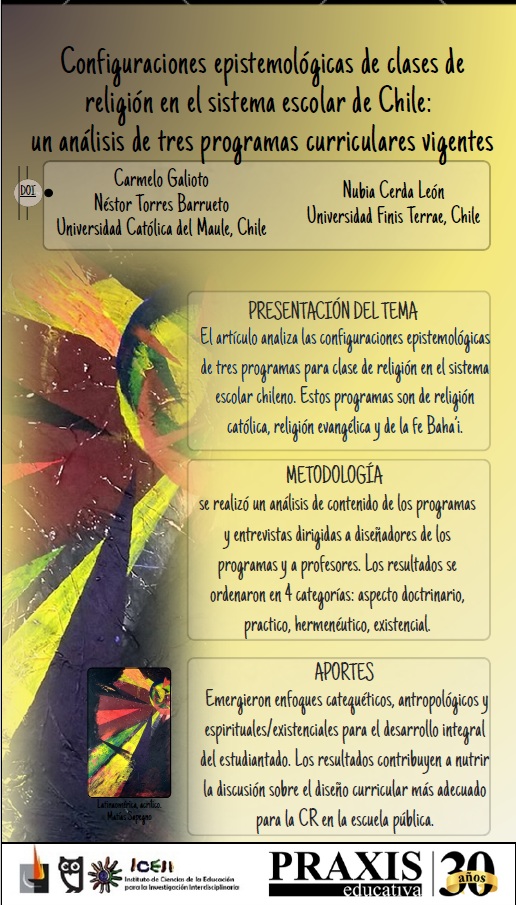
Configurações epistemológicas das aulas de religião no sistema escolar chileno: uma análise de três programas curriculares
DOI:
https://doi.org/10.19137/praxiseducativa-2026-300115Palavras-chave:
aula de religião, configurações epistemológicas, currículo, escola públicaResumo
Este artigo analisa as configurações de três programas de aulas de religião no sistema escolar chileno, concentrando-se nas abordagens e justificativas que os sustentam. Os três programas são: religião católica, religião evangélica e fé bahá'í. Com base numa análise de conteúdo, complementada por entrevistas desenvolvidas com criadores de programas e professores. Descobriu-se que o programa da religião católica baseia o seu conteúdo na revelação divina interpretada por uma tradição, o que desafia quem o lê. O programa de religião evangélica é baseado na Bíblia, que mostra uma verdade perene. O programa da fé bahá'í afirma que cada religião fornece aspectos da revelação divina: o seu conteúdo mostra componentes de várias religiões para avançar em direção à unidade da humanidade. Ao final do artigo, são discutidas algumas implicações desses resultados para a legitimidade das aulas de religião nas escolas públicas.
Downloads
Referências
Aldridge, D. (2011). What is religious education all about? A hermeneutic & Reappraisal. Journal of Belief & Values, 32(1), 33-45. https://doi.org/10.1080/13617672.2011.549308
Aldridge, D. (2023). Paul Hirst and religious education’s curriculum question: or how Hirst never thought religion was a form of knowledge at all. Journal of Philosophy of Education, 57, 337-352. https://doi.org/10.1093/jopedu/qhad014
Baeza-Correa, J., Imbarack-Dagach, P., Neckelmann, M., Reyes Ochoa, L... (2024). Deinstitutionalized Catholic Religiosity in Chilean Youth: A Lived Religion Approach. International Journal of Latina American Religions, 8, 564-587. https://doi.org/10.1007/s41603-024-00262-9
Barnes, L. P. (2022). Does the worldviews approach provide a new paradigma for religious education? En Religion and Worldviews. The triumph of the Secular in Religious Education. Routledge.
Becerra Duitama, E. (2023). Educación Religiosa Escolar: entre la obligatoriedad, la libertad religiosa y las percepciones de los agentes educativos. Revista de Educación Religiosa Escolar, 2(7), 173-191. https://orcid.org/0000-0002-9736-4622
Bellolio, C. (2024). Cultural Secularization and Political Secularism as Mirror Processes. The Case of Chile. International Journal of Latin American Religions, 8, 588-608 https://doi.org/10.1007/s41603-024-00268-3
Benjumea Loaiza, C. C. (2021). Apuntes para una Educación Religiosa en perspectiva no parametral. Revista De Educación Religiosa, 2(3), 81-101. https://doi.org/10.38123/rer.v2i3.184
Cantillo Cabrera, D. y Quintero Torres, F. (2020). Aportes de la educación religiosa escolar a la promoción del pluralismo religioso. Revista Hojas Y Hablas, (20), 84-96. https://doi.org/10.29151/hojasyhablas.n20a6
Carmody, B. (2024). Religious education: learning what from studying religions? British Journal of Religious Education, 47(3), 389-399. https://doi.org/10.1080/01416200.2024.2436919
Carr, D. (2007). Religious Education, Religious Literacy and Common Schooling: a Philosophy and History of Skewed Reflection, Journal of Philosophy of Education, 41(4), 659-673. https://doi.org/10.1111/j.1467-9752.2007.00586.x
CECH. (2020). Bases Curriculares y Programa de Estudio: Asignatura Religión Católica. Santillana.
Cerda, N., Soto, A. y Zúñiga, L. (2022). El nuevo programa de religión escolar católica: un cambio para el desarrollo espiritual y religioso. Santillana.
Chile. (1983). Decreto N° 924. Reglamenta clases de Religión en Establecimientos Educacionales. Diario Oficial de la República de Chile. Santiago, Chile, 7 de enero de 1984.
Clayton, M. y Stevens, D. (2018). What is the point of religious education? Theory and Research in Education, 16(1), 65-81. https://doi.org/10.1177/1477878518762217
Cooling, T. (2025). Knowledge in a religion and worldviews approach in english schools. British Journal of Religious Education, 47(2), 130-139. https://doi.org/10.1080/01416200.2024.2304693
Díaz, J. (2020). Religión Católica. Una asignatura con nuevas oportunidades y desafíos. Ediciones Universidad Finis Terrae.
Dunbar, R. (2024). Come la religione si è evoluta e perché continua a esistere. Mimesi.
Feinberg, W. y Layton, R. (2014). For the Civic Good. The Liberal Case for teaching religion in the public schools. The University of Michigan Press.
Franck, O. y Thalén, P. (Eds.). (2021). Religious Education in a Post-Secular Age Case Studies from Europe. Palgrave Macmillan.
Freathy, R. (2015). On Holy Ground: the theory and practice of Religious Education. Journal of Beliefs & Values, 36(1), 110-114. https://doi.org/10.1080/13617672.2015.1013823
Gaínza, A. (2006). La entrevista en profundidad individual. En M. Canales (Coord. y Ed.), Metodologías de la investigación social. Introducción a los oficios (pp. 219-263). LOM.
Galioto, C. y Bellolio, C. (2023). Towards a reform of religious teaching in the Chilean school system. International Journal of Educational Development, 100. https://doi.org/10.1016/j.ijedudev.2023.102791
Galioto, C. y Bellolio, C. (2024). La clase de religión en el sistema escolar de Chile: Problemas y perspectivas desde una aproximación filosófica. Pensamiento Educativo, 61(1), 1-15. https://doi.org/10.7764/PEL.61.1.2024.9
Gheaus, A. (2024). Enabling children to learn from religions whilst respecting their rights: against monopolies of influence, Journal of Philosophy of Education, 58, 120-127. https://doi.org/10.1093/jopedu/qhae007
Guerrero Díaz, T. (2020). Educación valórica inclusiva y los desafíos de la educación religiosa para ser garante de inclusión social. Revista Horizonte de la Ciencia, 10(18), 213-236. https://doi.org/10.26490/uncp.horizonteciencia.2020.18.401
Haecker, R. y Moulin-Stozek, D. (2021). Recollecting the Religious: Augustine in Answer to Meno’s Paradox. Studies in Philosophy and Education, 40(6). 567-578. https://doi.org/10.1007/s11217-021-09778-5
Hand, M. (2014). On the idea of non-confessional faith-based education. En: J. D. Chapman, S. McNamara, M. J. Reiss e Y. Waghid (Eds.), International Handbook of Learning, Teaching and Leading in Faith-Based Schools (pp.193-205). Springer.
Hand, M. (2015). Religious education and religious choice. Journal of Beliefs & Values, 36(1), 31-39,
https://doi.org/10.1080/13617672.2015.1013817
Hand, M. (2017). Is Religious Education Possible? A Philosophical Investigation. Bloomsbury Publishing.
Hannam, P. y Biesta, G. (2019). Religious education, a matter of understanding? reflections on the final report of the Commission on Religious Education. Journal of Beliefs & Values, 40(1), 55-63.
https://doi.org/10.1080/13617672.2018.1554330
Hernández-Sampieri, R., Fernández Collado, C. y Baptista Lucio, P. (2014). Metodología de la investigación. McGraw-Hill.
Hirst, P. H. (1973) Religion: A Form of Knowledge? A Reply. Learning for Living, 12, 8-10.
Juarez-Ramirez, B. (2020).La educación religiosa escolar en el siglo XXI: una respuesta formativa ante los nuevos escenarios. Revista de Educación Religiosa, 2(1), 9-39, https://doi.org/10.38123/rer.v2i1.44
Lewin, D. (2017). Educational Philosophy for a Post-secular Age. Routledge.
López, R., Moya, L. y Vargas, R. (2022). Habilidades del Siglo XXI y educación religiosa escolar: una interrelación necesaria para la formación integral del estudiantado. Revista de Educación Religiosa, 2(5), 40-58, https://doi.org/10.38123/rer.v2i5.262
Magendzo, A. K. (Coord.). (2008). Hacia una educación religiosa pluralista. Estudio diagnóstico de la educación religiosa en Chile y Colombia. Academia de Humanismo Cristiano.
Martínez, R. (2022). Modelos de educación religiosa escolar en América Latina. Revista de Educación Religiosa Escolar, 2(4), 9-36.https://doi.org/10.38123/rer.v2i4.219
Mondaca Guzmán, C. (2021). Opciones epistemológicas de la educación religiosa escolar para promover el pluralismo en la escuela. Revista de Educación Escolar, 2(7), 9-29. https://doi.org/10.38123/rer.v2i3.130
Muena-Jofre, M. y Fernández-Parada, A. (2024). Educación Religiosa Escolar Católica en Chile. Análisis de sus regulaciones y desarrollo curricular vigente en el contexto latinoamericano. Revista de Educación Religiosa, 3(1),88-103. https://doi.org/10.38123/rer.v3i1.436
Panjwani, F. (2023). (DIS)Locating Meaning: Toward a Hermeneutical Response in Education to Religiously Inspired Extremism. Educational Theory, 73, 452-461. https://doi.org/10.1111/edth.12585
Pring, R. (2018). The Future of Publicly Funded Faith Schools. A critical perspective. Routledge.
PUCV. (2017). Caracterización de la enseñanza de la religión a partir de la implementación del Decreto 924/1983 en las escuelas públicas de Chile. Informe final. MINEDUC y PNUD, Chile
Quintero-Torres, F. A. (2022). Representaciones sociales sobre educación religiosa escolar en una sociedad plural. Educación Y Educadores, 24(3), e2433. https://doi.org/10.5294/edu.2021.24.3.3
Roa Quintero, L. (2016). Prácticas pedagógicas en contextos de pluralidad religiosa en Colombia. Revista Horizonte de la Ciencia, 53(2), 1-14. https://doi.org/10.7764/PEL.53.2.2016.4
Rollins Gregory, M. (2014). The Procedurally Directive Approach to Teaching Controversial Issues, Educational Theory, 64(6), 627-648. https://doi.org/10.1111/edth.12087
Stern, J. (2023). Beyond knowledge-centred versus student-centred RE. British Journal of Religious Education, 45(3), 225-227. https://doi.org/10.1080/01416200.2023.2202076
Taylor, C. (2018). A Secular age. Belknap Press.
Tillson, J. (2019). Children, Religion, and the Ethics of Influence. Bloomsbury Academic.
Tillson, J. (2011). In Favour of Ethics Education, Against Religious Education. Journal of Philosophy of Education, 45(4), 675-688. https://doi.org/10.1111/j.1467-9752.2011.00829.x
Towey, A. (2022). The religious Education Commission 2016-18. A view from inside. En L. P. Barnes (Ed.),
Religion and Worldviews. The triumph of the Secular in Religious Education (pp. 18-39). Routledge.
Van der Leuw, G. (2017). Fenomenologia della religione. Bollati Boringhieri.
Vargas, F. y Moya, L. (2019). El desarrollo espiritual en la Educación Religiosa Escolar. En J. Meza, La religión en la escuela. Aproximaciones al objeto de estudio de la educación religiosa escolar (pp. 131-171). Editorial Pontificia Universidad Javeriana.
Publicado
Edição
Seção
Licença
Copyright (c) 2026 Carmelo Galioto, Nubia Cerda León, Néstor Torres Barrueto

Este trabalho está licenciado sob uma licença Creative Commons Attribution-NonCommercial-ShareAlike 4.0 International License.
Aviso de direitos autorais
Comitê Editorial Revista Práxis Educativa:
Declaro que sou o autor do artigo intitulado (nome do artigo), que o mesmo é original e de minha autoria e que não foi publicado anteriormente em qualquer outro formato ou meio. Declaro saber que a revista não me cobrará nenhum tipo de taxa em hipótese alguma, nem receberei qualquer tipo de remuneração monetária.
Caso seja aceito para publicação na Práxis Educacional, autorizo a referida revista a publicá-lo digitalmente e a divulgá-lo em suas redes sociais.
Se o trabalho for publicado, aderi à licença Creative Commons denominada "Atribuição - Compartilhamento Não Comercial pela mesma Licença CC BY-NC-SA", por meio da qual é permitido copiar, reproduzir, distribuir, comunicar publicamente o trabalho e gerar trabalhos derivados , desde que o autor original seja citado e reconhecido. Esta licença está em uso desde setembro de 2018. Em 2016 foi aderido ao CC BY NC ND 4.0; e nos anos de 2017 e 2018 (janeiro-agosto) CC BY NC 4.0.
Esta licença CC BY-NC-SA Share Alike não permite, entretanto, o uso comercial da obra. Como autor, a revista poderá estabelecer acordos adicionais para a distribuição não exclusiva da versão do trabalho publicado na revista, permite-me autoarquivar os artigos publicados, na sua versão post-print, em repositórios institucionais, temáticos , páginas web pessoais ou qualquer outro uso relevante. com o reconhecimento de ter sido publicado pela primeira vez nesta revista.
SA Práxis Educacional adere à DORA (Declaração sobre Avaliação de Pesquisa) assinada em São Francisco, Califórnia, em 16 de dezembro de 2012, e à Declaração do México (Declaração Conjunta LATINDEX - REDALYC - CLACSO - IBICT).









_(1)2.png)


3.png)








_(2).png)






2.jpg)