The tritrophic system of the ambrosia gall of Neolasioptera tridentifera (Diptera: Cecidomyiidae) on Heliotropium curassavicum (Boraginales: Heliotropiaceae): fungal, inducer and gall aspects
DOI:
https://doi.org/10.19137/semiarida.2026(1).5-17Keywords:
heliotrope, insect gall, life strategy, fungi, BotryosphaeriaAbstract
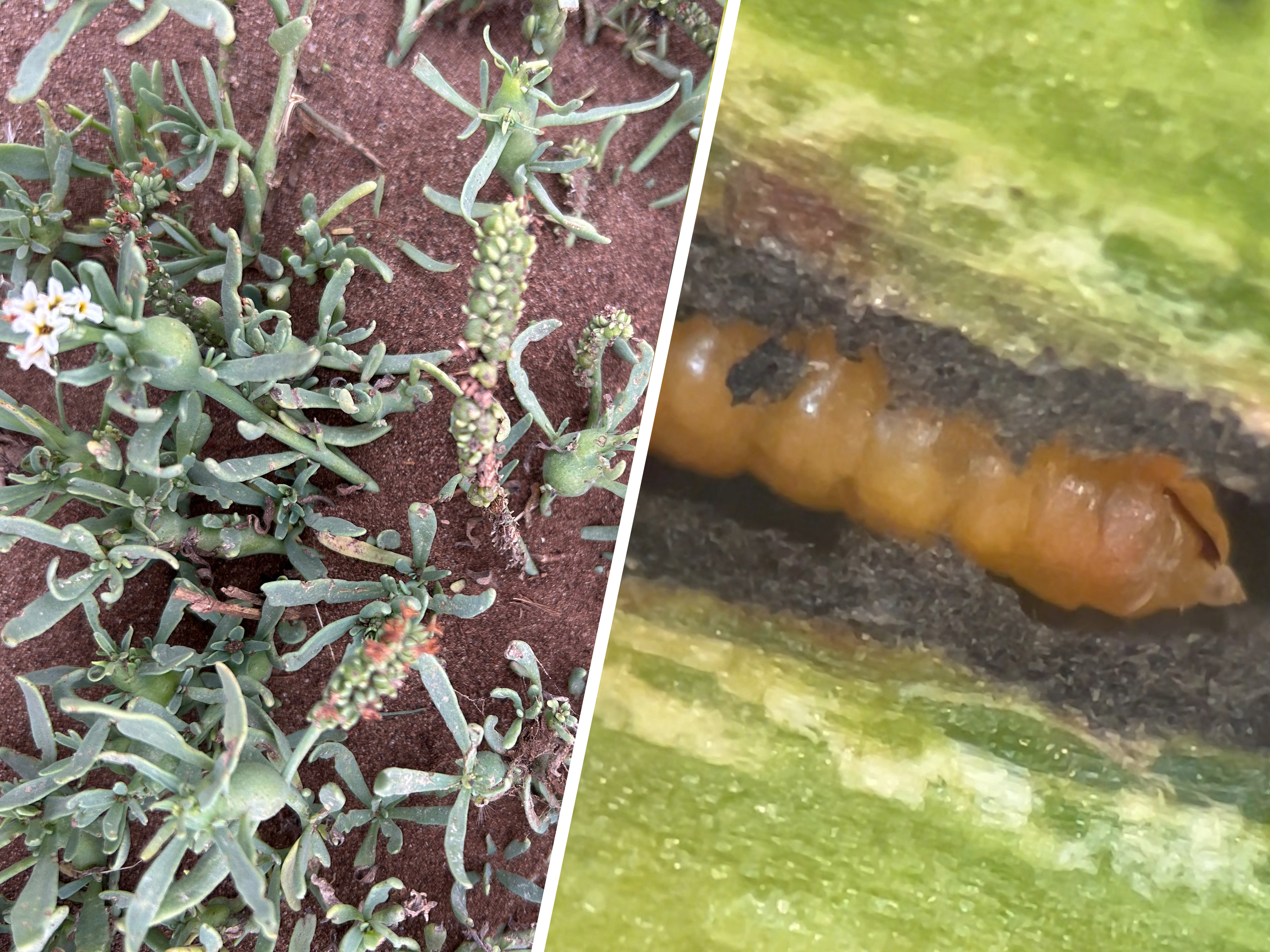
The cecidomyiid dipteran Neolasioptera tridentifera Kieffer & Jörgensen (Cecidomyiinae: Alycaulini) develops galls on the stems of heliotrope Heliotropium curassavicum L. (Boraginales: Heliotropiaceae). In field inspections, fungal mycelium was found together with the inducer inside the larval chamber of the galls. In this work, the morphological aspects of mature gall, the inducer's life strategy, and a first approach to the identification of mycelium are examined. The study was conducted on galls collected in Laguna Don Tomás, Santa Rosa, La Pampa. The anatomy of the gall was examined using microscopic preparations. In each season of the year, field inspections of the plants were carried out and gall dissections were carried out to investigate the life strategy. The study of the fungal mycelium was performed on samples extracted from the interior of the gall. The stem gall is fusiform and globoid, generally unilarval; the tunnel-like larval chamber develops in the parenchymal medulla, and the wall of the chamber is lined with fungal mycelium. The most abundant fungus obtained is a species of the genus Botryosphaeria (Dothideomycetes: Ascomycota). In the study area, the aerial parts of heliotrope plants die with frost and the galls remain attached to the plant, above the soil surface and half-buried, with third-instar larva inside. According to this, the inducer’s life strategy is type IB. In this work, it is reported for the first time that Neolasioptera tridentifera induces an ambrosia gall on Heliotropium curassavicum, and the presence of an associated fungal community is recorded, with a species of the genus Botryosphaeria being the most frequent.
Downloads
References
Adair, R. J., Burgess, T., Serdani, M., & Barber, P. (2009). Fungal associations in Asphondylia (Diptera: Cecidomyiidae) galls from Australia and South Africa: implications for biological control of invasive acacias. Fungal Ecology, 2, 122-134.
Akbar, W. A. S., Arokiarajan, M. S., Christopher, J. J., Ahmed, N. Z., & Meena, R. (2023). Evaluation of bioactive compounds as antimicrobial and antidiabetic agent from the crude extract of Heliotropium curassavicum L. Biocatalysis and Agricultural Biotechnology, 50, 102745. https://doi.org/10.1016/j.bcab.2023.102745
Al-Hadeethi, M. A., Al-Anbari, A. K., & Mohammed, A. T. (2018). Anatomical and palynological features of Heliotropium supinum L. In 9th International Conference on Advances in Engineering and Technology (RTET-2018), Londres, UK, https://doi.org/10.17758/EIRAI1.F0318103
Arduin, M., & Kraus, J. E. (2001). Anatomia de galhas de ambrosia em folhas de Baccharis concina e Baccharis dracunculifolia (Asteraceae). Revista Brasilera de Botánica, 24 (1), 63-72.
Bernardo, U., Nugnes, F., Gargiulo, S., Nicoletti, R., Becchimanzi, A., Stinca, A., & Viggiani, G. (2021). An integrative study on Asphondylia spp. (Diptera: Cecidomyiidae), causing flower galls on Lamiaceae, with description, phenology, and associated fungi of two new species. Insects, 12, 958, https://doi.org/10.3390/insects12110958
Borkent, A., & Bissett, J. (1985). Gall midges (Diptera: Cecidomyiidae) are vectors for their fungal symbionts. Symbiosis, 1, 185-194.
Brèthes, J. (1922). Himenópteros y dípteros de varias procedencias. Anales Sociedad Científica Argentina, 93, 119-146.
Bronner, R. (1992). The role of nutritive cells in the nutrition of Cynipids and Cecidomyiids. In J. D. Shorthouse y O. Rohfritsch (Eds.), Biology of Insect-Induced Galls (pp. 118-140). Oxford University Press.
Cano, E. (2004). Inventario integrado de los recursos naturales de la Provincia de La Pampa. Clima, Geomorfología, Suelo y Vegetación. 2ª Edición. Instituto Nacional de Tecnología Agropecuaria Provincia de La Pampa, Universidad Nacional de La Pampa.
Careddu, G., Botti, M., Cristofaro, M., Sporta Caputi, S., Calizza, E., Rossi, L., & Costantini, M. L. (2022). The Feeding behavior of gall midge larvae and its implications for biocontrol of the giant reed: Insights from stable isotope analysis. Biology, 11, 1805, https://doi.org/10.3390/biology11121805
Casagrande, G. A., Vergara, G. T. y Bellini, Y. (2006). Cartas agroclimáticas actuales de temperaturas, heladas y lluvia de la provincia de La Pampa (Argentina). Revista de la Facultad de Agronomía de la UNLPam, 17(1/2), 15- 22. https://cerac.unlpam.edu.ar/index.php/semiarida/article/view/4605/4755
Ceriani-Nakamurakare, E., Slodowicz, M., Gonzalez-Audino, P., Dolinko, A., & Carmaran, C. (2016). Mycobiota associated with the ambrosia beetle Megaplatypus mutatus: threat to poplar plantations. Forestry, 89 (2), 191-200, https://doi.org/10.1093/forestry/cpw001
Chao, J. F., & Liao, G. I. (2013). Histocytological aspects of four types of ambrosia galls on Machilus zuihoensis Hayata (Lauraceae). Flora, 208, 157-164.
D´Ambrogio de Argüeso, A. (1986). Manual de Técnicas en Histología Vegetal. Ed. Hemisferio Sur S. A.
Di Fulvio, T. E., y Espinar, L. A. (2016). Las especies argentinas de Heliotropium (Boraginaceae). Boletín de la Sociedad Argentina de Botánica, 51 (4), 745-787.
Dorchin, N., Harris, K. M., & Stireman III, J. O. (2019). Phylogeny of the gall midges (Diptera, Cecidomyiidae, Cecidomyiinae): Systematics, evolution of feeding modes and diversification rates. Molecular Phylogenetics and Evolution, 140, 1-15.
Dreger-Jaufret, F., & Shorthouse, J. D. (1992). Diversity of gall-inducing insects and their galls. In J. D. Shorthouse & O. Rohfritsch (Eds.), Biology of Insect-Induced Galls (pp. 8-33). Oxford University Press.
Esau, K. (1982). Anatomía de las plantas con semilla. Ed. Hemisferio Sur S. A.
Fahn, A. (1972). Plant anatomy. Pergamon Press Ltd., Headington Hill Hall, Oxford.
Gagné, R. J., & Jaschhof, M. (2021). A Catalog of the Cecidomyiidae (Diptera) of the world. Fifth Ed. Digital.
Heath, J. H., & Stireman III, J. O. (2010). Dissecting the association between a gall midge, Asteromyia carbonifera, and its symbiotic fungus, Botryosphaeria dothidea. Entomologia Experimentalis et Applicata, 137, 36-49, http://dx.doi.org/10.1111/j.1570-7458.2010.01040.x
Isaias, R. M. S., Carneiro, R. G. S., Oliveira D. C., & Santos, J. C. (2013). Illustrated and annotated checklist of brazilian gall morphotypes. Entomología Neotropical, 42, 230-239. http://dx.doi.org/10.1007/s13744-013-0115-7
Isaias, R. M. S., Kraus, J. E., Costa E. C., & Carneiro, R. G. S. (2024). The anatomy of neotropical galls and the untold lessons about the morphogenetical potentialities of plants. Rodriguésia, 75, e01542023. http://dx.doi.org/10.1590/2175-7860202475007
Jorge, N. C., Freitas, M.S.C., Caffaro, R. M., Vale, F. H. A., Lemos-Filho, J. P., & Isaias, R. M. S. (2022). Vascular traits of stem galls: Cell increment versus morphogenetic constraints in wood anatomy. Plant Biology, 24, 450-457, http://doi.org/10.1111/plb.13392
Jörgensen, P. (1916). Zoocecidios argentinos. Physis, 12(2), 360-365.
Jörgensen, P. (1917). Zoocecidios argentinos. Physis, 13(3), 1-29.
Kandemir, N., Çelik, A., Shah, S. N., & Razzaq, A. (2020). Comparative micro-anatomical investigation of genus Heliotropium (Boraginaceae) found in Turkey. Flora, 262, 151-495.
Kasem, W. T. (2015). Anatomical and micromorphological studies on seven species of Heliotropium L. (Boraginaceae Juss.) in South West of Saudi Arabia. American Journal of Plant Sciences, 6, 1370-1377.
Katalinic, V., Milos, M., Kulisic, T., & Jukic, M. (2006). Screening of 70 medicinal plant extracts for antioxidant capacity and total phenols. Food Chemistry, 94 (4), 550-557. https://doi.org/10.1016/j.foodchem.2004.12.004
Kieffer, J. J., & Jörgensen, P. (1910). Gallen und Gallentiere aus Argentinien. Nachdruck verboten, 362-444.
Kobune, S., Kajimura, H., Masuya, H., & Kubono, T. (2012). Symbiotic fungal flora in leaf galls induced by Illiciomyia yukawai (Diptera: Cecidomyiidae) and in Its mycangia. Microbial Ecology, 63, 619-627. https://doi.org/10.1007/s00248-011-9962-0
Kuzmanich, N., Altamirano, A. y Salvo, A. (2015). Agallas de insectos de la región Rioplatense, Buenos Aires, Argentina. Revista de la Sociedad Entomológica Argentina, 74 (1-2), 47-56.
Kuzmanich, N., Giorgis, M. A., & Salvo, A. (2018). Insect galls from Córdoba, Argentina: a case where stem galls predominate. Revista de Biología Tropical, 66 (3), 1135-1148, https://doi.org/10.15517/rbt.v66i3.31947
Mauseth, D. J. (1988). Plant Anatomy. The Benjamin/Cummings Publishing Company, Inc.
Mc Kay, F., Sosa, A. J., & Heard, T. A. (2014). Bionomics of Neolasioptera aculeata (Diptera: Cecidomyiidae), a promising biological control candidate against Parkinsonia aculeata (Fabaceae). Revista de la Sociedad Entomológica Argentina, 73 (1-2), 19-25.
Méndez, M., Vergara, G., Casagrande, G., y Bongianino, S. (2021). Clasificación climática de la región agrícola de la provincia de La Pampa, Argentina. Semiárida, 31(2), 9-20. http://dx.doi.org/10.19137/semiarida.2021(02).09-20
Monti, C., Novoa, M. C. y Vizcaíno, C. E. (2003). Anatomía y etnobotánica de dos especies de Boraginaceae de la Provincia pampeana (Argentina) usadas en medicina popular. Latin American Journal of Pharmacy, 22, 197-201.
Pan, L. Y., Chiang, T. Ch., Wen, Y. Ch., Chen, W. N., Hsiao, S. Ch., Tokuda, M., Tsai, Ch. L., & Yang M. M. (2015). Taxonomy and biology of a new ambrosia gall midge Daphnephila urnicola sp. nov. (Diptera: Cecidomyiidae) inducing urn-shaped leaf galls on two species of Machilus (Lauraceae) in Taiwan. Zootaxa, 3955 (3), 371-388. http://dx.doi.org/10.11646/zootaxa.3955.3.5
Pérez Cuadra, V. y Cambi, V. N. (2014). Ocurrencia de caracteres anatómicos funcionales foliares y caulinares en 35 especies xero-halófilas. Boletín de la Sociedad Argentina de Botánica, 49(3), 347-359.
Popescu, I. E., & Gostin, I. N. (2024). Lasioptera rubi, a pest of Rubus idaeus: Galls morphology, anatomy and histochemistry. Agriculture, 14, 1761. https://doi.org/10.3390/agriculture14101761
Pyszko, P., Šigutová, H., Kolařík, M., Kostovčík, M., Ševčík, J., Šigut, M., Višňovská, D., & Drozd, P. (2024). Mycobiomes of two distinct clades of ambrosia gall midges (Diptera: Cecidomyiidae) are species-specific in larvae but similar in nutritive mycelia. Microbiology Spectrum, 12, e02830-23. https://doi.org/10.1128/spectrum.02830-23
Pyszko, P., Šigutová, H., Ševčík, J., Drgová, M., Hařovská, D., & Drozd, P. (2025). Ambrosia gall midges (Diptera: Cecidomyiidae) and their microbial symbionts as a neglected model of fungus-farming evolution. FEMS Microbiology Reviews, 49, 1-17. https://doi.org/10.1093/femsre/fuaf010
Rohfritsch, O. (1992). Patterns in gall development. In J. D. Shorthouse & O. Rohfritsch (Eds.), Biology of Insect-Induced Galls (pp. 60-86), Oxford University Press.
Rohfritsch, O. (2008). Plants, gall midges, and fungi: a three-component system. Entomologia Experimentalis et Applicata, 128, 208-216 https://doi,org/10.1111/j.1570-7458.2008.00726.x
Roskam, J. C. (1992). Evolution of the gall-inducing guild. In J. D. Shorthouse & O. Rohfritsch (Eds.), Biology of Insect-Induced Galls (pp. 34-49), Oxford University Press.
Sá, C. E. M., Silveira, F. A. O., Santos, J. C., Isaias, R. M. D. S., & Fernandes, G. W. (2009). Anatomical and development aspects of leaf galls induced by Schizomyia macropillata Maia (Diptera: Cecidomyiidae) on Bahuinia brevipes Vogel (Fabaceae). Revista Brasileira de Botânica, 32(2), 319-327.
Slippers, B., & Wingfield, M. J. (2007). Botryosphaeriaceae as endophytes and latent pathogens of woody plants: diversity, ecology and impact. Fungal Biology Reviews, 21(2-3), 90-106, https://doi.org/10.1016/j.fbr.2007.06.002
Skuhravá, M., & Skuhravý, V. (1992). Biology of gall midges on common reed in Czechoslovakia. In J. D. Shorthouse & O. Rohfritsch (Eds.), Biology of Insect-Induced Galls (pp. 196-207), Oxford University Press.
White, T., Bruns, T., Lee, S., & Taylor, J. (1990). Amplification and direct sequencing of fungal ribosomal RNA genes for phylogenetics. In M. A. Innis, D. H. Gelfand, J. J. Sninsky & T. J. White (Eds.), PCR Protocols: A Guide to Methods and Applications (pp. 315-322), Academic Press, New York.
Yukawa, J., & Rohfritsch, O. (2005). Biology and Ecology of gall-inducing Cecidomyiidae (Diptera). In A. Raman, C. W. Schaefer & T. M. Withers (Eds.), Biology, Ecology, and Evolution of Gall-inducing Arthropods Vol. 1 (pp. 273-304), Science Publishers, Inc.
Yukawa, J., & Uechi, N. (2021). Chapter 6: Life history traits. In J. Yukawa, M. Tokuda (Eds.), Biology of Gall Midges, Entomology Monographs (pp. 119-149), Springer Nature Singapore Pte Ltd., https://doi.org/10.1007/978-981-33-6534-6_6
Zimowska, B., Okoń, S., Becchimanzi, A., Krol, E. D., & Nicoletti, R. (2020). Phylogenetic characterization of Botryosphaeria strains associated with Asphondylia galls on species of Lamiaceae. Diversity, 12(2), 41.
Downloads
Published
Issue
Section
License
La Editorial de la Universidad Nacional de La Pampa (EdUNLPam) exigirá a los/as autores/as la firma del siguiente documento:
La EdUNLPam lleva a cabo la publicación del artículo: (Título del Artículo) en SEMIÁRIDA Rev.Fac.Agron UNLPam ISSN 2362-4337 (impresa) ISSN 2408-4077 (en línea), del cual el/los abajo firmantes son autores de una o más partes. En el mismo acto, el/los autores entregan exclusivamente a la EdUNLPam todos sus derechos protegidos por las leyes de propiedad intelectual que rigen en la Argentina para reproducir, publicar, editar, fijar, comunicar y transmitir públicamente en cualquier formato o medio impreso o electrónico, inclusive internet, el artículo enviado a publicación e incluirlo en índices o bases de datos nacionales e internacionales. A cambio, la EdUNLPam entrega a los autores la autorización para la publicación o reimpresión con ines académicos y educativos en cualquier libro o medio de divulgación, con la sola obligación de citar el artículo original publicado en la EdUNLPam. Cada autor acuerda en que el material provisto a la EdUNLPam es un trabajo original, que no ha sido impreso o publicado en cualquier otro medio con anterioridad y que no vulnera derechos de terceros. El Primer autor tendrá la posibilidad de leer y corregir el artículo ya editado como “prueba de galera”, pero si el autor no devolviera esas correcciones de la prueba de galera dentro del tiempo especificado, el proceso de producción y publicación podrá proseguir sin la aprobación del autor. El/los autor/es no recibirán compensación monetaria de la EdUNLPam por el uso del material contenido en este artículo y asumen la responsabilidad de las opiniones vertidas en él.






.png)



22.png)


.jpg)




.jpg)