They choose less, but do better: the paradoxical behavior of women in the engineering field
DOI:
https://doi.org/10.19137/praxiseducativa-2024-280212Keywords:
stereotypes; higher education; engineering; gender equality; equal opportunityAbstract
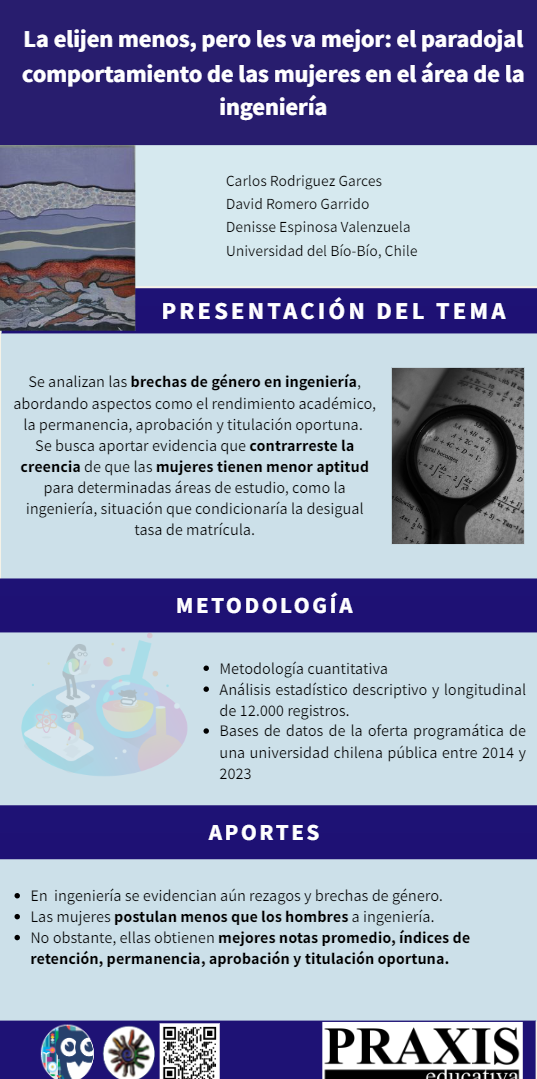
It analyzes the behavior of enrollment and academic performance of men and women in careers with low female presence. After creating a set of indexes of gender gaps and internal efficiency, a descriptive and longitudinal statistical analysis of academic registration databases of the programmatic offerings of a public university between 2014 and 2023 was performed. As a result, women apply less to engineering, but once they choose this option, they show a better academic performance. Although female enrollment has expanded, in areas such as engineering there is evidence of lags and gaps. It is women who show higher rates of retention, permanence, approval and timely graduation, in addition to presenting a significantly higher average performance. The argument of lower mathematical competencies of women to explain their professional choices in engineering is questioned. It highlights the importance of socio-educational interventions of attitudinal change that expand their choices to this área.
Published
Issue
Section
License
Copyright (c) 2024 Carlos Rodríguez Garcés, David Romero-Garrido, Denisse Espinosa-Valenzuela

This work is licensed under a Creative Commons Attribution-NonCommercial-ShareAlike 4.0 International License.
Copyright Notice
Editorial Committee Educational Praxis Magazine:
I hereby declare that I am the author of the article titled (article name), that it is original and my own and that it was not previously published in any other format or medium. I declare to know that the magazine will not charge me any type of fee under any circumstances, nor will I receive any type of monetary compensation If it were accepted for publication in Educational Praxis, I authorize the aforementioned magazine to publish it digitally and to advertise it on its social networks.
If the work is published, I adhere to the Creative Commons license called "Attribution - Non-Commercial Share Alike CC BY-NC-SA", through which it is allowed to copy, reproduce, distribute, publicly communicate the work and generate derivative works, as long as when the original author is cited and acknowledged. This license has been used since September 2018. In 2016 CC BY NC ND 4.0 was adhered to; and in the years 2017 and 2018 (January-August) CC BY NC 4.0.
This CC BY-NC-SA Share Alike license does not, however, permit commercial use of the work. As an author, the journal may establish additional agreements for the non-exclusive distribution of the version of the work published in the journal, it allows me to self-archive the published articles, in their post-print version, in institutional, thematic repositories, personal web pages or any other relevant use. with the recognition of having been first published in this journal.
Educational Praxis adheres to DORA (Declaration on Research Assessment) signed in San Francisco, California, on December 16, 2012, and to the Declaration of Mexico (Joint Declaration LATINDEX - REDALYC - CLACSO - IBICT).
How to Cite










_(1)2.png)