Production of probiotic lactobacilli biomass for in-feed supplementation to growing pigs and sows
Production of probiotic lactobacilli biomass for in-feed supplementation to growing pigs and sows
DOI:
https://doi.org/10.19137/cienvet.v28.9434Keywords:
Technological properties, Spray dryer, Probiotic formulations, PigsAbstract
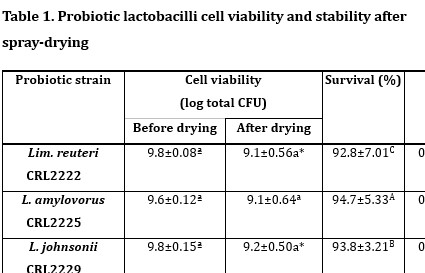
In the design of probiotic formulations, preservation of microorganism’s viability is the most important parameter to evaluate at the time of administration. In this study, the impact of spray-drying on the preservation of probiotic strains isolated from pig feces: Limosilactobacillus reuteri CRL2222, Lactobacillus amylovorus CRL2225 and Lactobacillus johnsonii CRL2229 was studied, by using a previously formulated protectant mix. The three probiotic strains displayed high resistance to spray-drying operating conditions and subsequent storage, showing survivability’s between 92.9 and 94.7%; probiotic powders exhibited low water activity (aw:0.2) and moisture content ranging from 3.3±0.16 and 3.8±0.46. The used trehalose/maltodextrin/soy protein/sodium glutamate/calcium phosphate protectant mix showed high thermal protection during the process, allowing high final viability. When probiotic functionality of the strains was evaluated, hydrophobic character was maintained. Thus, it may be highlight that both viability and functionality of probiotics was preserved after spray-drying, characteristics that are strain-specific.
References
Anee IJ, Alam S, Begum RA, Shahjahan RM, Khandaker AM (2021) The role of probiotics on animal health and nutrition. J of Basic Appl Zool. https://doi.org/10.1186/s41936-021-00250-x
Mamphogoro TP, Makete G, Modika KY, Kamutando CN (2024) Probiotics as feed additives for improved animal health and nutrition: The current perspectives. In Probiotics, Prebiotics, and Postbiotics in Human Health and Sustainable Food Systems, pp. 1-27, chapter 1, A. Vilela and A. Inês (Editors), IntechOpen. DOI: 10.5772/intechopen.1007406
Dowarah R, Verma A, Agarwal N (2017) The use of Lactobacillus as an alternative of antibiotic growth promoters in pigs: A review. Animal Nutrition. https://doi.org/10.1016/j.aninu.2016.11.002
Tang KL, Caffrey NP, Nóbrega DB, Cork SC, Ronksley PE, Barkema HW, Polachek AJ, Ganshorn H, Sharma N, Kellner JD, Ghali WA (2017) Restricting the use of antibiotics in food-producing animals and its associations with antibiotic resistance in food-producing animals and human beings: a systematic review and meta-analysis. Lancet Planet Health. https://doi.org/10.1016/S2542-5196(17)30141-9
Wang J, Li S, Tang W, Diao H, Zhang H, Yan H (2023a) Dietary complex probiotic supplementation changed the composition of intestinal short-chain fatty acids and improved the average daily gain of growing pigs. Veterinary Science. https://doi.org./10.3390/vetsci10020079
Mansilla FI, Aristimuño Ficoseco C, Miranda MH, Puglisi E, Nader‑Macías MEF, Vignolo G, Fontana CA (2022) Administration of probiotic lactic acid bacteria to modulate fecal microbiome in feedlot cattle. Scientific Reports. https://doi.org/10.1038/s41598-022-16786-z
Zamojska D, Nowak A, Nowak I, Macierzyńska-Piotrowska E (2021) Probiotics and postbiotics as substitutes of antibiotics in farm animals: A Review. Animals (Basel). https://doi.org/10.3390/ani11123431.
Aristimuño Ficoseco C, Mansilla FI, Maldonado NC, Miranda H, Nader-Macias MEF, Vignolo GM (2018) Safety and growth optimization of lactic acid bacteria isolated from feedlot cattle for probiotic formula design. Front Microb. https://doi.org/10.3389/fmicb.2018.02220
Aristimuño Ficoseco C, Mansilla FI, Vignolo GM, Nader-Macías MEF (2023) Optimization of probiotic lactobacilli production for in-feed supplementation to feedlot cattle. Appl Microbiol. https://doi.org/10.3390/applmicrobiol3020024
Selvamani S, Dailin DJ, Rostom M, Malek RA, Gupta VK, El-Enshasy HA (2020) Optimizing medium components to enhance high cell mass production of biotherapeutic strain Lactobacillus reuteri DSM 20016T by statistical method. Journal of Science & Industrial Research. https://doi.org/10.56042/jsir.v79i9.41715
Huang S, Vignolles ML, Chen XD, Le Loir Y, Jan G, Schuck P (2017) Spray drying of probiotics and other food-grade bacteria: A review. Trends Food Sci. Technol. https://doi.org/10.1016/j.tifs.2017.02.007
Vinderola G, Binetti A, Burns P, Reinheimer J (2011) Cell viability and functionality of probiotic bacteria in dairy products. Front. Microbiol. https://doi.org/10.3389/fmicb.2011.00070
Peighambardoust SH, Golshan Taftia A, Hesari J (2011) Application of spray drying for preservation of lactic acid starter cultures: a review. Trends Food Sci. Technol. https://doi.org/10.1016/j.tifs.2011.01.009
Vinderola G, Champagne CP, Desfossés-Foucault E (2019) The production of lactic acid bacteria starters and probiotic cultures. An industrial perspective. En: Lactic Acid Bacteria. Microbiological and Functional Aspects. 317-336. CRC Press-Taylor& Francis Group.
Iaconelli C, Lemetais G, Kechaou N, Chain F, Bermúdez-Humarán LG, Langella P (2015) Drying process strongly affects probiotics viability and functionalities. J. Biotechnol. https://doi.org/10.1016/j.jbiotec.2015.08.022
Uezen JD, Aristimuño Ficoseco C, Nader-Macías MEF, Vignolo GM (2023) Identification and characterization of potential probiotic lactic acid bacteria isolated from pig feces at various production stages. Can. J. Vet. Res. 87, 127-145.
Russo MI, Abeijón-Mukdsi MC, Santacruz A, Ross R, Malo AL, Gauffin-Cano P, Medina RB (2022) Spray dried lactobacilli maintain viability and feruloyl esterase activity during prolonged storage and under gastrointestinal tract conditions. J Food Sci Technol. https://doi.org/10.1007/s13197-021-05125-1
Meter Group Inc (2024a) AQUALAB 4TE water activity meter: Technical specifications and operating principles. https://aqualab.com/en/products/aqualab-4te/aqualab-4te-tech-specs
AOAC International (2024) Official methods of analysis of AOAC International (22nd ed.). AOAC International.
Meter Group Inc (2024b) Water activity measurement using chilled mirror dew point technology. https://aqualab.com/products/aqualab-4te-water-activity-meter
Fontana AJ (2024) Water activity in foods: Fundamentals and applications. CRC Press.
Rahman MS (2024) Handbook of food preservation (3rd ed.). CRC Press.
Rosenberg M, Doyle RJ. Microbial cell surface hydrophobicity: history, measurement, and significance. Microbial Cell Surface Hydrophobicity. 1990; 1-37.
Ocaña VS, de Ruiz Holgado AA, Nader-Macías MEF. Selection of vaginal H2O2-generating Lactobacillus species for probiotic use. Curr Microbiol. 1999; 38: 279-84
Vandervoorde L, Christiaens H, Verstraete W. Prevalence of coaggregation among chicken lactobacilli. J Appl Bacteriol. 1992; 72: 214-219
Ocaña VS, Nader-Macías MEF. Vaginal lactobacilli: self and co-aggregation. Br J Biomed Sci. 2003; 59: 183-190
Guan N, Li L (2020) Microbial response to acid stress: Mechanisms and applications. Appl. Microb. Biotech. https://doi.org/10.1007/s00253-019-10226-1
Barbosa J, Borges S, Teixeira P (2015) Influence of sub-lethal stresses on the survival of lactic acid bacteria after stray-drying in orange juice. Food Microbiol. Htpps://doi.org/10.1016/j.fm.2015.06.010
Behboudi-Jobbbehdar S, Soukoulis C, Yonekura L, Fisk I (2013) Optimization of spray-drying process condition for the production of maximally viable microencapsulated L. acidophilus NCIMB 701748. Drying Technol. https://doi.org/10.1080/07373937.2013.788509
Poddar D, Das S, Jones G, Palmer J, Jameson GB, Haverkamp RG (2014) Stability of probiotic Lactobacillus paracasei during storage as affected by the drying method. Int. Dairy J. 39, 1-7. https://doi.org/10.1016/j.idairyj.2014.04.007
Broeckx G, Vandenheuvel D, Henkens T, Kiekens S, van den Broek MFL, Lebeer S, Kiekens F (2017) Enhancing the viability of Lactobacillus rhamnosus GG after spray drying and during storage. Int. J. Pharm. https://doi.org/10.1016/j.ijpharm.2017.09.075
Guergoletto KB, Busanello M, Garcia S (2017) Influence of carrier agents on the survival of Lactobacillus reuteri LR92 and the physicochemical properties of fermented juçara pulp produced by spray drying. LWT. https://doi.org/10.1016/j.lwt.2017.02.038
Dumitru M, Lefter NA, Habeanu M, Ciurescu G, Vodnar DC, Elemer S, Sorescu I, Georgescu SE, Dudu A (2023) Evaluation of Lactic Acid Bacteria isolated from piglets tract and encapsulation of selected probiotic cells. Agriculture. https://doi.org/10.3390/agriculture13051098
Savedboworn W, Teawsomboonkit K, Surichay S, Riansa-Ngawong W, Rittisak S, Charoen R, Phattayakorn K (2019) Impact of protectants on the storage stability of freeze-dried probiotic Lactobacillus plantarum. Food Sci. Biotechnol. https://doi.org/10.1007/s10068-018-0523-x
Duong T, Barrangou R, Russell, W.M., Klaenhammer, T.R. (2006). Characterization of the tre locus and analysis of trehalose cryoprotection in Lactobacillus acidophilus NCFM. Appl. Environ. Microbiol. https://doi.org/10.1128/AEM.72.2.1218-1225.2006
Xiao Z, Xia J, Zhao Q, Niu Y, Zhao D (2022) Maltodextrin as wall material for microcapsules: A review. Carbohydrate polymers. https://doi.org/10.1016/j.carbpol.2022.120113
Wang Y, Hao F, Lu W, Suo X, Bellenger E, Fu N (2020) Enhanced thermal stability of lactic acid bacteria during spray drying by intracellular accumulation of calcium. J. Food Eng. https://doi.org/10.1016/j.jfoodeng.2020.109975
Santivarangkna C, Kulozik U, Foerst P (2008) Alternative drying processes for the industrial preservation of lactic acid starter cultures. Biotechnol. Prog. https://doi.org/10.1021/bp060268f
Wang F, Mutukumira AN (2022) Microencapsulation of Limosilactobacillus reuteri DPC16 by spray drying using different encapsulation wall materials. J. Food Process. Preserv. https://doi.org/10.1111/jfpp.16880
Kiekens S, Vandenheuvel D, Broeckx G, Claes I, Allonsius C, De Boeck I (2019) Impact of spray-drying on the pili of Lactobacillus rhamnosus GG. Microb. Biotechnol. https://doi.org/10.1111/1751-7915.13426
Downloads
Published
Issue
Section
License
Copyright (c) 2026 Jose David Uezen, María Hortencia Miranda, Mariano Obregozo, Maria Cecilia Aristimuño Ficoseco, María Elena Fátima Nader Macías, Graciela Margarita Vignolo

This work is licensed under a Creative Commons Attribution-NonCommercial-ShareAlike 4.0 International License.
Al momento de enviar sus contribuciones, los colaboradores deberán declarar , de manera fehaciente, que poseen el permiso del archivo o repositorio donde se obtuvieron los documentos que se anexan al trabajo, cualquiera sea su formato (manuscritos inéditos, imágenes, archivos audiovisuales, etc.), permiso que los autoriza a publicarlos y reproducirlos, liberando a la revista y sus editores de toda responsabilidad o reclamo de terceros , los autores deben adherir a la licencia Creative Commons denominada “Atribución - No Comercial CC BY-NC-SA”, mediante la cual el autor permite copiar, reproducir, distribuir, comunicar públicamente la obra y generar obras derivadas, siempre y cuando se cite y reconozca al autor original. No se permite, sin embargo, utilizar la obra con fines comerciales.
How to Cite





.jpg)